
Cover Story
The Santiniketan experience
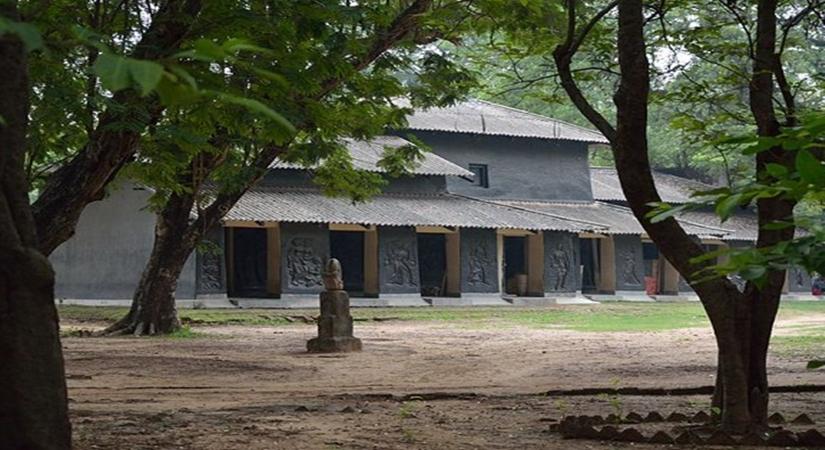
Tagore's abode of peace in Bolpur district, offers visitors the opportunity to appreciate his unique style of teaching in natural surroundings.
ByShona Adhikari
November 1, 2019 (IANSlife) Santiniketan, Rabindra Nath Tagore's abode of peace in Bolpur district, offers visitors the opportunity to see and appreciate Tagore's unique style of teaching in natural surroundings. Over the years, Santiniketan has grown to become a very popular place for short holidays.
The 'Santiniketan Experience' begins almost immediately after the train leaves Howrah. The Santiniketan Express with its chair cars, is the most popular train between Kolkata and Bolpur. Also, since it halts at Burdwan, travellers from the north can also board at this busy junction. A constant stream of vendors, wander in and out selling local crafts. Kantha embroidered bags of all sizes are available at throw-away prices - there are many who cannot resist buying the convenient mobile bags that can be strung from the neck like necklaces.
As one nears Bolpur, we are entertained by some wonderful singers with melodious Rabindra Sangeet, who board the train a couple of stations before we reach Bolpur. A blind singer with a harmonium hung from his shoulder is among the most popular of the regular singers who readily obliges requests from the travellers.
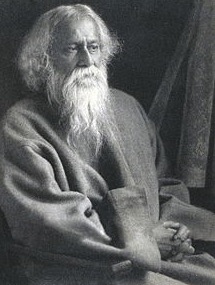
Tagore's abode of art and culture, was built on land given to his father by the zamindars of Surul. Located within Bolpur, Santiniketan's origins date back to the time when his father the austere Maharishi Debendranath, a rather restless man, found peace here in this solitary tract of land. A marble seat under a 'chatim' tree marks the spot where Debendranath sat and decided on building a temple which would be open to all. The design of the temple was borrowed freely from various architectural styles - circular in shape, it has windows with coloured panes and looks much like an unusual cottage. Debendranath had also built a guest house and planted an orchard before naming the place Santiniketan or 'abode of peace'. This was 40 years before his son, Rabindranath Tagore the poet Nobel Laureate, established his dream school at Santiniketan in 1921. The rest is history.
Santiniketan lies 2 km from the Bolpur railway station. The recent visit had stirred up memories of a much earlier visit, when Santiniketan was almost like a village with very few hotels or restaurants. At the time, transport was limited to cycle-rickshaws used only by the old and infirm, while everyone else either walked or cycled. I recollect arriving by train in a group of six, including two children, from Calcutta on the Santiniketan Express -- a journey of just over two hours. Coming out of the tiny station, we were accosted by a horde of cycle-rickshaw and taxi drivers.
Bolpur with its splendid red earth, is known to be covered with a profusion of flowers and foliage most of the year. The Santhali women in their handloom sarees with their upright figures, burnished complexions and flowers in their hair, earn their keep by working at hotels guest houses and small eateries. While their work has not undergone many changes, their style of dressing like so much of India certainly has. They are often seen dressed in jazzy salwar kameezes and nylon sarees in place of their traditional handlooms.
Bolpur falls within the Birbhum area, famous for its terracotta images and crafts, while the terracotta temples are even more famous. It is a good idea to set out early to see the renowned terracotta temples within Bolpur. Most of these are built in the traditional style - some with a typical `Gaur' roof and others with spired roofs. The exteriors offer some very fine engravings with scenes from the legend of "Mahishasura Mardini" -- the fearsome battle waged by Goddess Durga on the asuras.
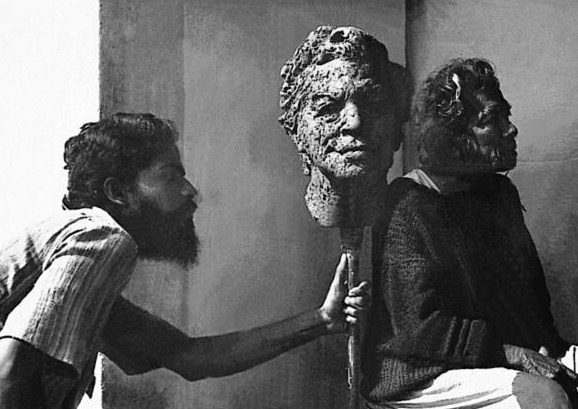
Kala Bhawan, is the art department of the Viswa Bharati University, nurtured by some of India's best-known artists. Besides the stalwarts from Tagore's time, Nandalal Bose, Benod Behari Mukhopadhyaya and Ram Kinkar Baiz, there are also Mukul Dey, KG Subramium, Somenath Hore and countless others, whose works are scattered around the campus. Ram Kinkar Baiz, himself a Santhal had created huge concrete sculptures of Santhali families that he placed in the grounds of Kala Bhawan. These continue to be the biggest attractions at Kala Bhawan. Also worth seeing are Somnath Hore's murals in relief and KG Subramanium's sculpture of a group of crocodiles and tortoises as well as his mural that covers the whole front of the studio where he took his classes.
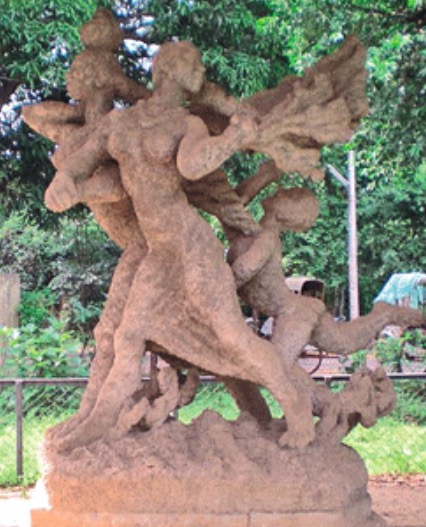
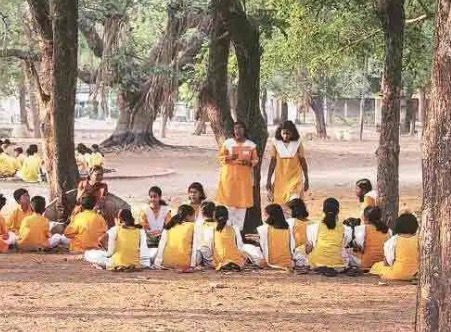
Under the trees, cemented platforms remind us that Tagore had envisioned his 'Poet's School' as a place of learning to be held as close to nature as possible. We can often see a group of students in animated discussions under the spreading branches of an ancient tree.
Any visit to Santiniketan would be incomplete without a glimpse into the local handicrafts of the area. Amar Kutir is a society for rural development, which was started as an ashram or commune, for political prisoners. The ashram was later transformed into a design centre for saree printing, kantha-work, leather craft and pottery. Other handicrafts made in the region are also displayed and sold here.
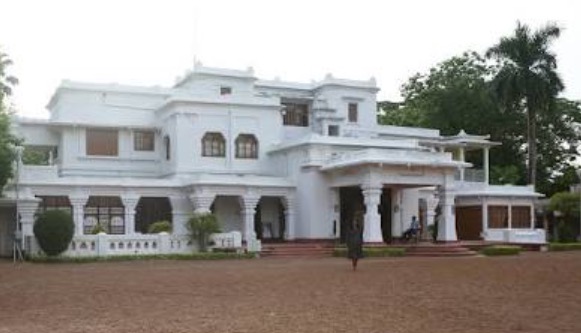
A visit to Santiniketan should include a visit also to see several other temples in the region which are under the care of the Archaeological Survey of India (ASI) and INTACH. November onwards till March is the best time to visit Bolpur. January is the most popular time for visits and it is often difficult to find space in the many hotels and guest houses that have sprung up in the past two decades.
A comparatively new happening is the Sanivar Haat (Saturday Fair) makes the weekends full of people, making the most of the Baul music and sale of local artifacts. But the main rush is for the "Paus Mela", held in January/February, this is when one can sample the best of food, buy handicrafts and enjoy the music. This is where we also get to see crafts sold by the Santhalis -- the most popular items being tribal silver jewellery, paintings, embroidered items such as cushion covers and bedcovers and locally woven handloom and kantha embroidered sarees.
(This article is a website exclusive and cannot be reproduced without the permission of IANSlife)
IANSlife can be contacted at ianslife@ians.in
Editing by Vinamra Gupta